When researching noise suppression in power supply circuits, you may come across a component called a Y capacitor.
This article uses diagrams to explain the following topics:
- What Y capacitors are and what they do
- Differences between subclasses Y1, Y2, and Y4
- The relationship between capacitance and leakage current
- Electric shock precautions
What Is a Y Capacitor?
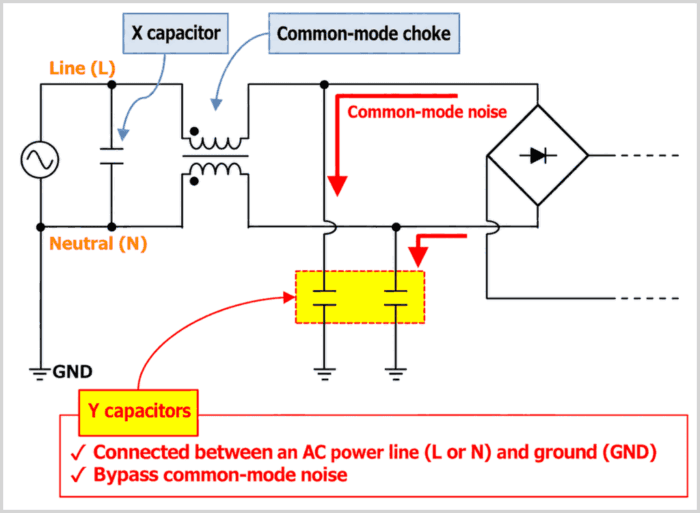
A Y capacitor is a capacitor connected between an AC power line—line (L) or neutral (N)—and ground (GND).
Y capacitors help suppress common-mode noise. By providing a bypass path for high-frequency noise current, they can reduce the noise flowing back to the input side (the AC supply). They are generally said to be particularly effective at frequencies of 1 MHz and above.
Because Y capacitors are connected on the primary side, they may be exposed to surge voltages from the AC supply. Y capacitors are therefore divided into classifications called subclasses according to the surge voltages they can withstand. Select a component with a subclass suitable for the surge voltages it will encounter.
The following section explains these subclasses.
Note
- Ceramic capacitors are often used as Y capacitors, but safety-approved film capacitors and other types are also available.
- Y capacitors are also called line bypass capacitors.
Y Capacitor Subclasses
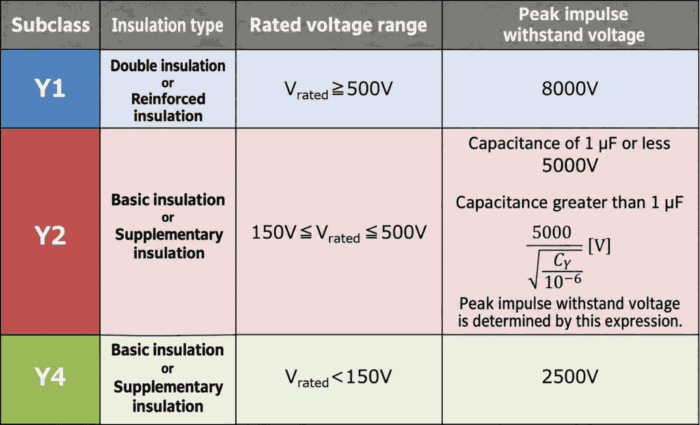
As shown in the table above, Y capacitors are classified into subclasses Y1, Y2, and Y4. These subclasses differ in the type of insulation they support, their rated voltage range, and their peak impulse withstand voltage. The lower the number after Y, the greater the surge voltage withstand capability.
Note
Basic insulation provides the basic level of protection against electric shock. Supplementary insulation provides additional protection in case the basic insulation fails. Double insulation combines basic and supplementary insulation, while reinforced insulation provides protection equivalent to double insulation.
Subclass Y1
- Suitable for double insulation or reinforced insulation.
- Rated voltage range: up to 500 V AC.
- Peak impulse withstand voltage: 8000 V.
Subclass Y2
- Suitable for basic insulation or supplementary insulation.
- Rated voltage range: 150 V AC to 500 V AC, inclusive.
- Peak impulse withstand voltage: 5000 V for capacitances of 1 μF or less. For capacitances greater than 1 μF, the voltage is determined by the expression \(\displaystyle\frac{5000}{\sqrt{\displaystyle\frac{C_Y}{10^{-6}}}}\).
In this expression, \(C_Y\) is the capacitance of the Y capacitor, in \(\mathrm{F}\) (farads). The calculated voltage is in \(\mathrm{V}\) (volts).
Subclass Y4
- Suitable for basic insulation or supplementary insulation.
- Rated voltage range: below 150 V AC.
- Peak impulse withstand voltage: 2500 V.
The peak impulse withstand voltages listed above apply under the test conditions specified by the standard. They do not mean that these voltages can be applied continuously. To determine the permissible operating voltage, check the voltage rating of the specific component.
Y Capacitor Leakage Current
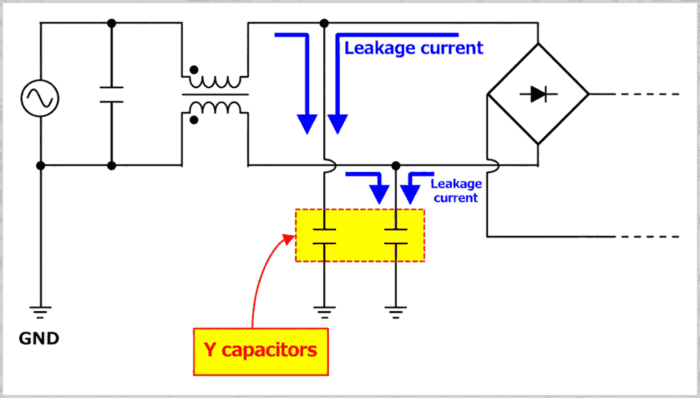
Y capacitors commonly have capacitances of 470 pF to 4700 pF. However, the higher the capacitance, the greater the leakage current flowing through the Y capacitor. You therefore cannot increase its capacitance based solely on the desired noise suppression performance.
If the product does not meet its applicable leakage current requirements, the circuit must be reviewed—for example, by reducing the capacitance of the Y capacitor.
Y Capacitors and Electric Shock
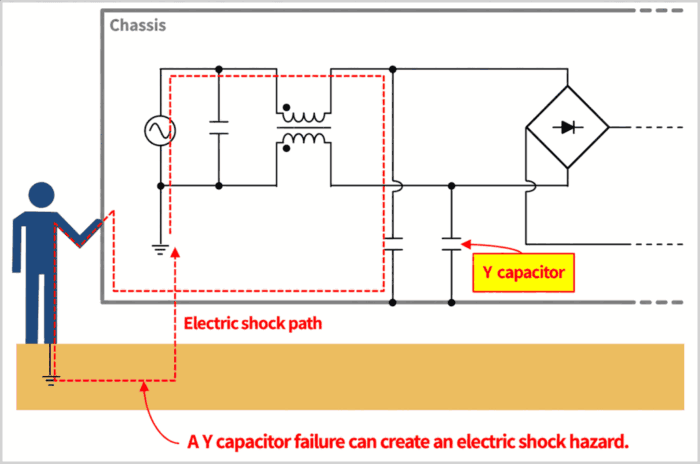
Because Y capacitors are connected between the power lines and earth, a short-circuit failure in a Y capacitor can create an electric shock hazard, as shown in the diagram above.
For this reason, Y capacitors must be safety-approved components intended for applications where electric shock hazards must be considered. Do not replace a Y capacitor with an ordinary capacitor that merely has a high voltage rating, or with a capacitor approved only for Class X applications.
Summary
This article explained the following key points about Y capacitors:
- A Y capacitor is a safety-approved capacitor used to reduce common-mode noise by connecting between a power line and ground, among other applications.
- Increasing capacitance also increases leakage current, so noise suppression must be balanced with safety requirements.
- A short-circuit failure can create an electric shock hazard. Always use a safety-approved Y-class capacitor suitable for the application.
Thank you for reading.