When researching noise suppression in power supply circuits, you may come across a component called an X capacitor.
Where is an X capacitor connected, and what does it do?
This article uses diagrams to explain the following aspects of X capacitors in an easy-to-understand way:
- What X capacitors do
- How to select an X capacitor
- Electric shock precautions after unplugging the AC power plug
What Is an X Capacitor?
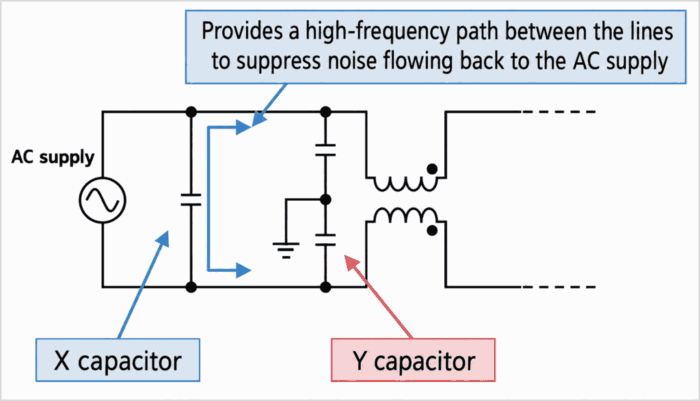
An X capacitor is a safety-rated capacitor connected across the AC supply lines to reduce noise. In a single-phase line-to-neutral supply, it is connected between line (L) and neutral (N).
Its purpose is to reduce differential-mode conducted noise voltage by effectively shorting the supply lines together at high frequencies. Here, “shorting at high frequencies” means providing a path between the lines that allows high-frequency noise current to flow easily. This suppresses high-frequency noise current generated inside the equipment from traveling through the power cord back to the AC supply, reducing conducted noise voltage at the supply terminals.
As frequency becomes higher, a capacitor’s impedance becomes lower. At high frequencies, its impedance can therefore be regarded as almost zero. Connecting a capacitor across the supply lines thus effectively shorts the lines together at high frequencies.
Note
- X capacitors are also called line-to-line capacitors, differential-mode capacitors, or across-the-line capacitors.
- As a side note, I have read that increasing an X capacitor’s capacitance is particularly effective against noise in the lower frequency range of 150 kHz to 1 MHz.
How to Select an X Capacitor
When selecting an X capacitor, the main factors to check are its voltage rating, capacitance, and surge-voltage subclass.
Voltage Rating
Select an AC voltage rating suitable for the maximum operating voltage, including variations in the AC supply voltage. Check the rated AC voltage, operating temperature, and other conditions specified in the datasheet.
Capacitance
Choose the capacitance according to the frequency and magnitude of the differential-mode noise you want to reduce. At a given frequency within the range where the capacitor behaves capacitively, increasing capacitance lowers its impedance, making it easier to bypass noise.
However, increasing capacitance does not necessarily reduce noise at every frequency. The effectiveness depends on the component’s frequency characteristics, wiring, and surrounding circuitry, so verify it by measuring noise in the actual equipment. Increasing capacitance also increases the stored charge, so discharge after unplugging must be considered.
Surge Voltage
Because an X capacitor is connected directly to the AC supply, it is exposed to surge voltages on the supply lines. A surge voltage is a brief high voltage caused by events such as lightning or switching.
You therefore need to select an X capacitor that can withstand the surge voltages expected on the supply lines.
X capacitors are divided into subclasses under IEC 60384-14. Common examples are subclass X1 and subclass X2. X2 capacitors are used for applications with expected peak pulse voltages up to \(2.5{\mathrm{[kV]}}\), while X1 capacitors are required for applications with expected peak pulse voltages above \(2.5{\mathrm{[kV]}}\) and up to \(4.0{\mathrm{[kV]}}\).
Electric Shock Precautions
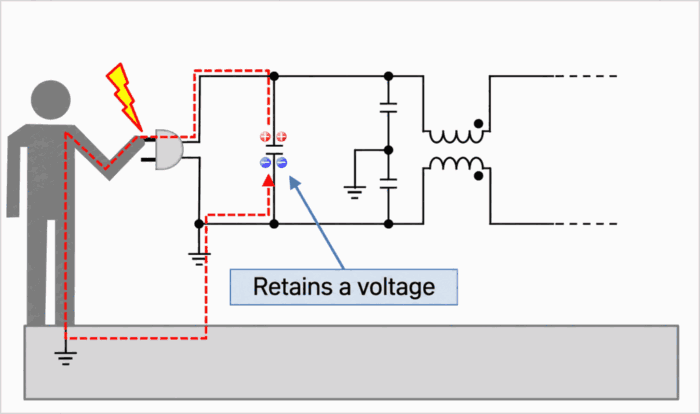
An X capacitor is connected across the supply lines. When the AC power plug is unplugged, the capacitor can retain charge, leaving a voltage across the plug pins. In this situation, touching the plug pins can cause an electric shock.
The voltage across the X capacitor must therefore be reduced to a specified level within a specified time. The required discharge time and voltage limit depend on the safety standard applicable to the product and its intended market. Check the relevant edition and test conditions rather than treating a requirement from one country or product category as universal. A common method is to connect a bleeder resistor in parallel with the X capacitor to discharge the stored charge. A dedicated discharge circuit can also be used.
X Capacitors vs. Y Capacitors
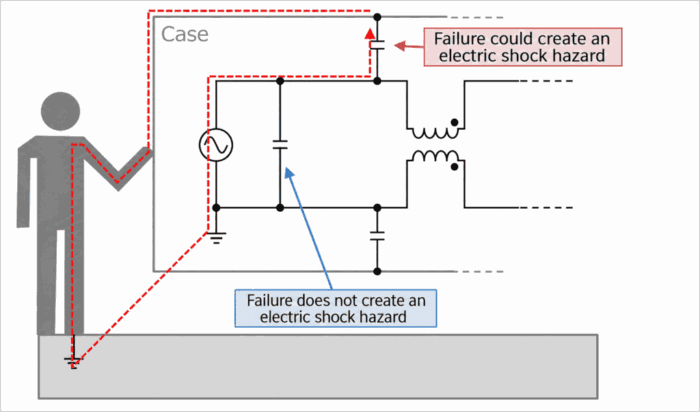
X capacitors are connected across the supply lines, whereas Y capacitors are connected between a supply line and earth (ground), among other locations. X capacitors are mainly used to reduce differential-mode noise, while Y capacitors reduce common-mode noise. Common-mode noise flows in the same direction through the 2 supply lines and returns through a path such as earth.
Because an X capacitor is connected across the supply lines rather than between a supply line and earth, its failure does not create an electric shock hazard.
Y capacitors, on the other hand, are used in locations where capacitor failure could create an electric shock hazard, so they must provide the high reliability required for that application. An X capacitor must therefore never be used in place of a Y capacitor.
Related Article
For more details on Y capacitors, which are connected between supply lines and earth, among other locations, see the following article covering their function and leakage current. 続きを見る
What Is a Y Capacitor? Classes, Leakage Current, and Safety Explained
Summary
This article explained the following points about X capacitors:
- X capacitors are connected across the supply lines to reduce differential-mode noise.
- When selecting an X capacitor, check its AC voltage rating, capacitance, and subclass.
- Actual noise suppression also depends on the component’s frequency characteristics and wiring.
- Be aware of residual charge after unplugging, and provide discharge measures that meet the applicable safety standard.
Thank you for reading.