When you connect a device to a battery, the battery voltage may drop. A key concept for understanding this behavior is the battery’s internal resistance.
This article explains the following aspects of battery internal resistance using diagrams:
- The meaning of battery internal resistance \(r\) and its equivalent circuit
- The difference between electromotive force and terminal voltage, and the equation relating them
- How to read the terminal voltage–current graph
- Current and terminal voltage under open-circuit and short-circuit conditions
What Is Battery Internal Resistance?
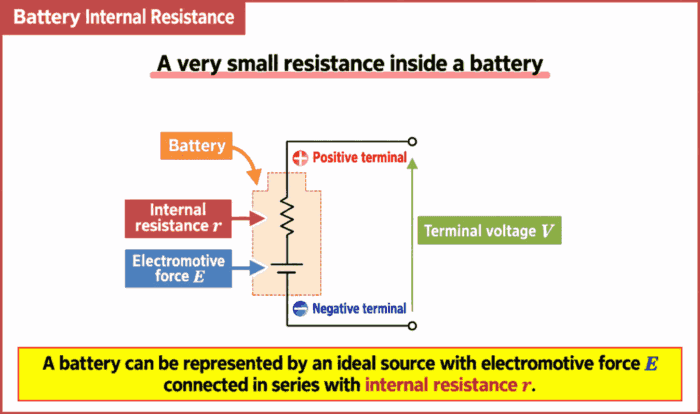
A battery has a very small resistance \(r\) inside it. This resistance \(r\) is called internal resistance.
As shown in the diagram above, a battery can therefore be represented by an ideal source with an electromotive force \(E\), connected in series with an internal resistance \(r\).
The electromotive force \(E\) is the voltage produced by the battery’s chemical reactions. Its unit is \({\mathrm{[V]}}\) (volts). The terminal voltage \(V\), on the other hand, is the voltage between the battery’s positive and negative terminals. This is the voltage applied to a device or resistor connected to the battery. Like electromotive force, terminal voltage is measured in \({\mathrm{[V]}}\).
More precisely, internal resistance represents the effects within a battery that oppose current flow and cause a voltage drop. It does not mean that a separate resistor is physically installed inside the battery. For circuit calculations, the effects of the electrodes, electrolyte, and other internal components are combined into a single resistance.
Relationship Between Battery Electromotive Force \(E\) and Terminal Voltage \(V\)
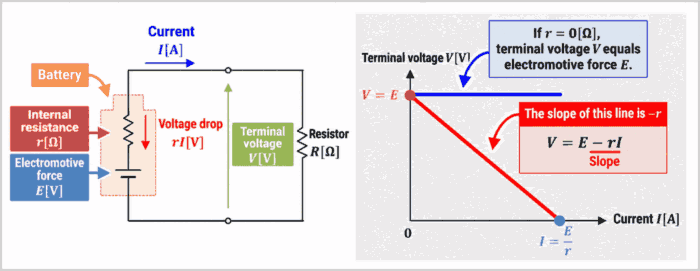
The left side of the diagram above shows a battery with an electromotive force of \(E{\mathrm{[V]}}\) and an internal resistance of \(r{\mathrm{[{\Omega}]}}\), connected to a resistor with a resistance of \(R{\mathrm{[{\Omega}]}}\).
On the right side, the graph shows the battery terminal voltage \(V\) on the vertical axis and the current \(I\) flowing from the battery on the horizontal axis.
For an ideal battery with an internal resistance \(r\) of \(0{\mathrm{[{\Omega}]}}\), no voltage drop \(rI\) occurs across the internal resistance, even when current \(I\) flows. The electromotive force \(E\) and terminal voltage \(V\) are therefore equal (the blue line in the graph above).
However, a real battery has an internal resistance \(r\). When current \(I\) flows, a voltage drop \(rI\) occurs across this resistance, making the battery terminal voltage \(V\) lower than its electromotive force \(E\) (\(V {\leq} E\)).
In this circuit, the electromotive force \(E\) equals the sum of the voltage \(rI\) across the internal resistance and the terminal voltage \(V\) across the external resistor. The relationship between electromotive force and terminal voltage is therefore expressed by the following equation:
\begin{eqnarray}
E&=&rI+V\\
\\
{\Leftrightarrow}V&=&E-rI\tag{1}
\end{eqnarray}
Equation (1) shows that the terminal voltage \(V\) equals the electromotive force \(E\) minus the voltage drop \(rI\) across the internal resistance \(r\). The unit of \(rI\) is \({\mathrm{[V]}}\). It represents the reduction in voltage caused by current \(I\) flowing through the internal resistance \(r\).
If the electromotive force \(E\) and internal resistance \(r\) remain constant, increasing the current \(I\) increases the voltage drop \(rI\), reducing the battery terminal voltage \(V\). Plotting Equation (1) gives the red line in the graph above.
When the current \(I\) is \(0{\mathrm{[A]}}\), the terminal voltage \(V\) equals the electromotive force \(E\) (\(V=E\)). When the current \(I\) is \(\displaystyle\frac{E}{r}{\mathrm{[A]}}\), the terminal voltage \(V\) is \(0{\mathrm{[V]}}\). Equation (1) also shows that the slope of the line is \(-r\). The larger the internal resistance \(r\), the greater the decrease in terminal voltage \(V\) for a given increase in current \(I\).
Next, let us look more closely at how to draw this graph.
When the Current \(I\) Flowing from the Battery Is \(0{\mathrm{[A]}}\)
![When the Current I Flowing from the Battery Is 0[A]](https://electrical-information.com/wp-content/uploads/2026/10/When-the-Current-I-Flowing-from-the-Battery-Is-0A-700x314.png)
Substituting \(I=0{\mathrm{[A]}}\) into Equation (1) gives the point where the red line intersects the graph’s vertical axis (terminal voltage \(V\)).
Let us calculate this point.
Substituting \(I=0{\mathrm{[A]}}\) into Equation (1) gives the following terminal voltage \(V\):
\begin{eqnarray}
V&=&E-rI\\
\\
&=&E-r×0\\
\\
&=&E{\mathrm{[V]}}\tag{2}
\end{eqnarray}
The red line therefore intersects the vertical axis (terminal voltage \(V\)) at \(E{\mathrm{[V]}}\).
When the current \(I\) flowing from the battery is \(0{\mathrm{[A]}}\), the voltage drop \(rI\) across the internal resistance \(r\) is \(0{\mathrm{[V]}}\). The terminal voltage \(V\) and electromotive force \(E\) are therefore equal (\(V=E\)).
When is the current flowing from the battery 0[A]?
This occurs when the resistor \(R\) is not connected to the battery, or when the circuit is disconnected at some point to create an open circuit, as shown in the diagram above. The current path is interrupted, so the current \(I\) flowing from the battery is \(0{\mathrm{[A]}}\).
When the Terminal Voltage \(V\) Is \(0{\mathrm{[V]}}\)
![When the Terminal Voltage V Is 0[V]](https://electrical-information.com/wp-content/uploads/2026/10/When-the-Terminal-Voltage-V-Is-0V-700x336.png)
Substituting \(V=0{\mathrm{[V]}}\) into Equation (1) gives the point where the red line intersects the graph’s horizontal axis (current \(I\)).
Let us calculate this point.
Substituting \(V=0{\mathrm{[V]}}\) into Equation (1) gives the following current \(I\) flowing from the battery:
\begin{eqnarray}
V&=&E-rI\\
\\
{\Leftrightarrow}I&=&\frac{E-V}{r}\\
\\
&=&\frac{E-0}{r}\\
\\
&=&\frac{E}{r}\tag{3}
\end{eqnarray}
The red line therefore intersects the horizontal axis (current \(I\)) at \(\displaystyle\frac{E}{r}{\mathrm{[A]}}\).
Connecting the point where the current \(I\) flowing from the battery is \(0{\mathrm{[A]}}\) (where \(V=E{\mathrm{[V]}}\)) to the point where the terminal voltage \(V\) is \(0{\mathrm{[V]}}\) (where \(I=\displaystyle\frac{E}{r}{\mathrm{[A]}}\)) gives the red line representing the relationship between the battery terminal voltage \(V\) and the current \(I\) flowing from the battery.
When is the terminal voltage V equal to 0[V]?
The terminal voltage \(V\) becomes \(0{\mathrm{[V]}}\) when the two ends of the resistor \(R\) are connected by a wire with no resistance, creating a short circuit, as shown in the diagram above.
First, consider the circuit before it is short-circuited. When current \(I\) flows through the external resistor \(R\), Ohm’s law gives the voltage \(V\) across it as follows:
\begin{eqnarray}
V=RI\tag{4}
\end{eqnarray}
If the entire external load is represented by the resistance \(R\), an ideal short circuit can be treated as \(R=0{\mathrm{[{\Omega}]}}\). In this case, the voltage across \(R\) (the terminal voltage \(V\)) is \(0{\mathrm{[V]}}\), as shown by the following equation:
\begin{eqnarray}
V=RI=0×I=0{\mathrm{[V]}}\tag{5}
\end{eqnarray}
Related Article
An open circuit interrupts the current path, while a short circuit connects two points through a path with very low resistance. The following article explains the difference between open circuits and short circuits in more detail. 続きを見る
Open Circuit vs. Short Circuit: Differences
Summary
This article explained the following points about battery internal resistance and the relationship between electromotive force and terminal voltage:
- A battery can be represented by an equivalent circuit consisting of an ideal source with an electromotive force \(E\), connected in series with an internal resistance \(r\).
- During discharge, the terminal voltage is \(V=E-rI\). If the electromotive force \(E\) and internal resistance \(r\) remain constant, the terminal voltage decreases as the current \(I\) increases.
- No current flows in an open circuit, so the terminal voltage \(V\) equals the electromotive force \(E\) in this equivalent circuit.
- Under ideal short-circuit conditions with an internal resistance \(r>0\), the terminal voltage \(V\) is zero and the current is \(\displaystyle\frac{E}{r}\). Do not short-circuit a real battery.
Thank you for reading.