What does a bleeder resistor do at the output of a power supply?
This article uses diagrams to explain:
- What a bleeder resistor is
- The main uses of a bleeder resistor
- How to calculate its resistance and power dissipation
What Is a Bleeder Resistor?
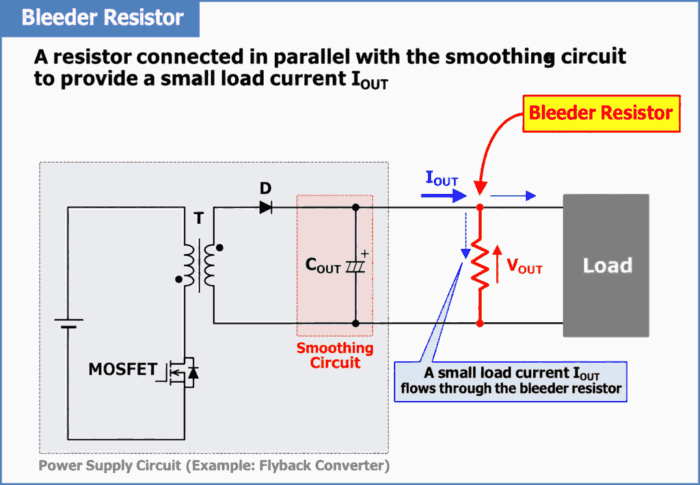
A bleeder resistor is connected in parallel with the smoothing circuit to provide a small load current.
With no bleeder resistor connected, the power supply is at no load when the load current \(I_{OUT}\) is \(0{\mathrm{[A]}}\) and at light load when a small load current flows. A bleeder resistor is used to stabilize the output voltage \(V_{OUT}\) under these conditions.
Some circuits need a certain amount of load current to operate reliably. For example, at no load, the MOSFET in a power supply like the flyback converter shown above may switch erratically, or the power supply may have trouble responding to sudden changes in load. In this case, connecting a bleeder resistor in parallel with the smoothing circuit allows some load current \(I_{OUT}\) to flow, preventing a no-load condition and helping the circuit operate reliably.
Note
A bleeder resistor is sometimes called a dummy load resistor.
Purpose of a Bleeder Resistor
The two main purposes of a bleeder resistor are stabilizing the output voltage and discharging the smoothing capacitor.
- Stabilizing the output voltage
- In a power supply that requires a minimum load current, the output voltage may drift from its set value at no load or light load. When a bleeder resistor is connected, current flows through it even when there is no external load. This can stabilize both the switching operation and the output voltage. It can also help the power supply respond to sudden changes in load in some cases.
- Discharging the smoothing capacitor
- After the power supply is switched off, the output voltage \(V_{OUT}\) remains as long as the output smoothing capacitor \(C_{OUT}\) holds a charge. The output voltage \(V_{OUT}\) gradually falls as the capacitor discharges. The larger the capacitance of \(C_{OUT}\), the longer it takes for \(V_{OUT}\) to fall. A bleeder resistor can be used to discharge \(C_{OUT}\) and bring the output voltage \(V_{OUT}\) down more quickly.
How to Calculate Bleeder Resistor Resistance and Power Dissipation
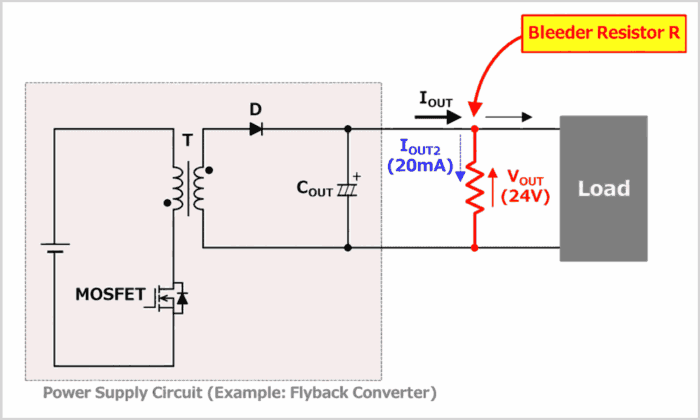
As an example, consider the flyback converter shown above under the following conditions:
- Output voltage \(V_{OUT}=24{\mathrm{[V]}}\)
- Current through the bleeder resistor \(I_{OUT2}=20{\mathrm{[mA]}}\)
Let’s calculate the resistance \(R\) and power dissipation \(P_{LOSS}\) of the bleeder resistor.
The voltage across the bleeder resistor is equal to the output voltage \(V_{OUT}\). Using Ohm’s law, we can calculate the resistance \(R\) as follows.
\begin{eqnarray}
R=\frac{V_{OUT}}{I_{OUT2}}=\frac{24}{20×10^{-3}}=1.2{\mathrm{[k{\Omega}]}}
\end{eqnarray}
The power dissipation \(P_{LOSS}\) of the bleeder resistor is given by the following equation.
\begin{eqnarray}
P_{LOSS}=\frac{{V_{OUT}}^2}{R}=\frac{24^2}{1.2×10^3}=0.48{\mathrm{[W]}}
\end{eqnarray}
The resistor heats up as it dissipates this power \(P_{LOSS}\). The smaller the ratio of the power dissipation \(P_{LOSS}\) to the rated power \(P_{RATED}\), the smaller the temperature rise. Choose a resistor with a rated power \(P_{RATED}\) comfortably above the power it will dissipate.
If you cannot find a resistor with sufficient margin in its rated power \(P_{RATED}\), you can connect several resistors in parallel. Choose their values so that the equivalent resistance matches the required resistance. This spreads the power dissipation across the resistors and reduces the power each one must dissipate.
Summary
This article covered:
- What a bleeder resistor is
- How a bleeder resistor is used and how to calculate its resistance and power dissipation
Thank you for reading.