When studying electric circuits, you will come across the terms “electric potential” and “voltage.” Since both use the same unit, you may find it difficult to understand how they differ.
Electric potential is the electrical “height” relative to a reference point, while voltage is the difference in electric potential between two points. This article uses diagrams to explain electric potential and voltage, covering the following topics:
- The meanings of electric potential and voltage, and how they differ
- Calculations for a circuit with dry cells connected in series
- Understanding electric potential and voltage through elevation and elevation difference
- How changing the reference point affects electric potential and voltage
The Difference Between Electric Potential and Voltage
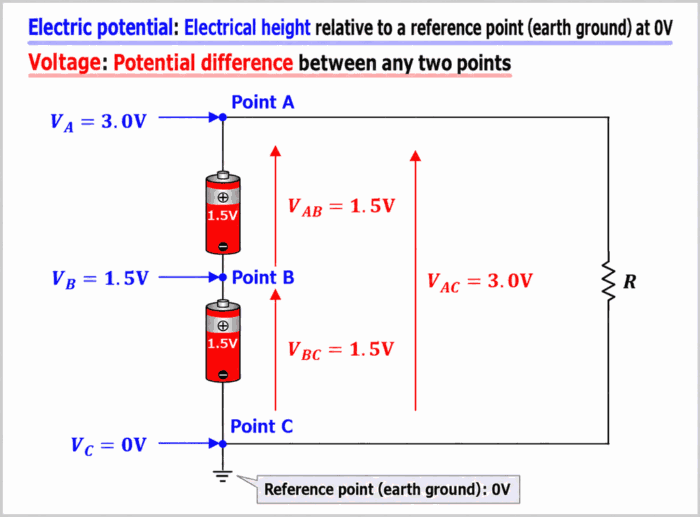
Electric potential is the electrical “height” relative to a reference point (usually earth ground) defined as \(0{\mathrm{V}}\).
In contrast, voltage is the difference in electric potential between any two points. Voltage is also called potential difference.
Both electric potential and voltage (potential difference) are measured in \({\mathrm{V}}\) (volts).
Consider a circuit with two \(1.5{\mathrm{V}}\) dry cells connected in series, as shown above. First, taking point C as the \(0{\mathrm{V}}\) reference point (earth ground), the electric potentials at points A, B, and C are as follows.
Electric potential at point A, \(V_A\):
From the reference point, there are two \(1.5{\mathrm{V}}\) dry cells connected in series, so the electric potential is higher by the combined voltage of the two cells.
\begin{eqnarray}
V_A=3.0{\mathrm{V}}({\Leftarrow}{\;}1.5{\mathrm{V}}+1.5{\mathrm{V}})
\end{eqnarray}
Electric potential at point B, \(V_B\):
From the reference point, there is one \(1.5{\mathrm{V}}\) dry cell, so the electric potential is higher by the voltage of one cell.
\begin{eqnarray}
V_B=1.5{\mathrm{V}}
\end{eqnarray}
Electric potential at point C, \(V_C\):
Point C is the reference point, so its electric potential is as follows.
\begin{eqnarray}
V_C=0{\mathrm{V}}
\end{eqnarray}
Next, we calculate the voltages (potential differences) between A and B, A and C, and B and C. In this article, \(V_{AB}\) means “the voltage at point A relative to point B,” calculated by subtracting the electric potential at B from that at A. For \(V_{AC}\) and \(V_{BC}\), we likewise subtract the potential at the second point in the subscript from the potential at the first.
Voltage between A and B, \(V_{AB}\):
Subtract the electric potential at B (\(V_B=1.5{\mathrm{V}}\)) from the electric potential at A (\(V_A=3.0{\mathrm{V}}\)).
\begin{eqnarray}
V_{AB}=V_A-V_B=3.0{\mathrm{V}}-1.5{\mathrm{V}}=1.5{\mathrm{V}}
\end{eqnarray}
Voltage between A and C, \(V_{AC}\):
Subtract the electric potential at C (\(V_C=0{\mathrm{V}}\)) from the electric potential at A (\(V_A=3.0{\mathrm{V}}\)).
\begin{eqnarray}
V_{AC}=V_A-V_C=3.0{\mathrm{V}}-0{\mathrm{V}}=3.0{\mathrm{V}}
\end{eqnarray}
Voltage between B and C, \(V_{BC}\):
Subtract the electric potential at C (\(V_C=0{\mathrm{V}}\)) from the electric potential at B (\(V_B=1.5{\mathrm{V}}\)).
\begin{eqnarray}
V_{BC}=V_B-V_C=1.5{\mathrm{V}}-0{\mathrm{V}}=1.5{\mathrm{V}}
\end{eqnarray}
For example, \(V_{AB}=1.5{\mathrm{V}}\) means that the electric potential at A is \(1.5{\mathrm{V}}\) higher than at B. Reversing the order of the two points reverses the sign of the voltage. In this example, the voltage at B relative to A, \(V_{BA}\), is \(-1.5{\mathrm{V}}\).
Understanding Electric Potential and Voltage Through Elevation and Elevation Difference
The difference between electric potential and voltage is easier to visualize using elevation and elevation difference, as shown below.
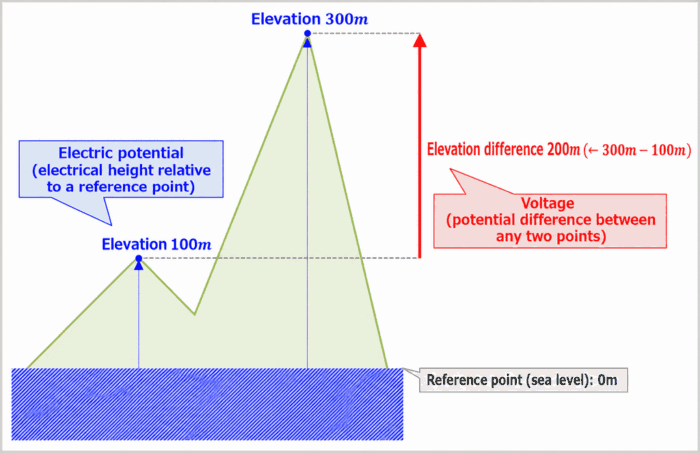
Electric potential (electrical “height” relative to a reference point) is like elevation (height above sea level), while voltage (potential difference between any two points) is like elevation difference (the difference in height between any two points).
In the diagram, the elevations relative to sea level are \(300{\mathrm{m}}\) and \(100{\mathrm{m}}\), so the elevation difference is \(200{\mathrm{m}}\).
Electric Potential and Voltage with Point B as the Reference Point (Earth Ground)
Previously, we used point C as the reference point (earth ground). Now, let us calculate the electric potentials and voltages with point B as the \(0{\mathrm{V}}\) reference point, as shown below.
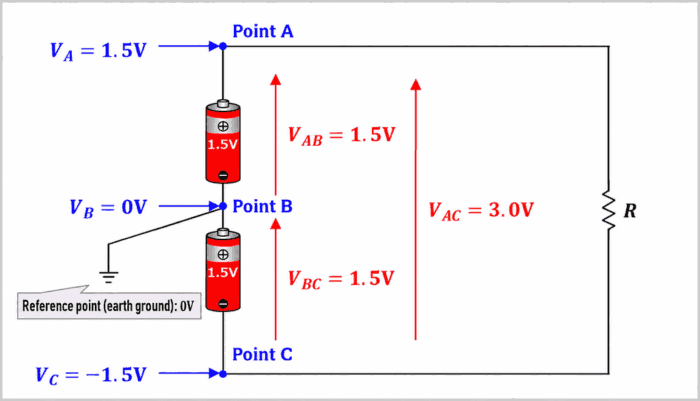
Taking point B as the reference point (earth ground), the electric potentials at points A, B, and C are as follows.
Electric potential at point A, \(V_A\):
From the reference point, there is one \(1.5{\mathrm{V}}\) dry cell, so the electric potential is higher by the voltage of one cell.
\begin{eqnarray}
V_A=1.5{\mathrm{V}}
\end{eqnarray}
Electric potential at point B, \(V_B\):
Point B is the reference point, so its electric potential is as follows.
\begin{eqnarray}
V_B=0{\mathrm{V}}
\end{eqnarray}
Electric potential at point C, \(V_C\):
From the reference point, there is one \(1.5{\mathrm{V}}\) dry cell, so the electric potential is lower by the voltage of one cell.
\begin{eqnarray}
V_C=-1.5{\mathrm{V}}
\end{eqnarray}
Since the positive terminal of the lower dry cell (point B) is defined as \(0{\mathrm{V}}\), its negative terminal (point C) has an electric potential of \(-1.5{\mathrm{V}}\). A negative electric potential means that the potential is lower than at the chosen reference point.
We also calculate the voltages (potential differences) between A and B, A and C, and B and C by subtracting the electric potentials in the same order as before.
Voltage between A and B, \(V_{AB}\):
Subtract the electric potential at B (\(V_B=0{\mathrm{V}}\)) from the electric potential at A (\(V_A=1.5{\mathrm{V}}\)).
\begin{eqnarray}
V_{AB}=V_A-V_B=1.5{\mathrm{V}}-0{\mathrm{V}}=1.5{\mathrm{V}}
\end{eqnarray}
Voltage between A and C, \(V_{AC}\):
Subtract the electric potential at C (\(V_C=-1.5{\mathrm{V}}\)) from the electric potential at A (\(V_A=1.5{\mathrm{V}}\)).
\begin{eqnarray}
V_{AC}=V_A-V_C=1.5{\mathrm{V}}-(-1.5{\mathrm{V}})=3.0{\mathrm{V}}
\end{eqnarray}
Voltage between B and C, \(V_{BC}\):
Subtract the electric potential at C (\(V_C=-1.5{\mathrm{V}}\)) from the electric potential at B (\(V_B=0{\mathrm{V}}\)).
\begin{eqnarray}
V_{BC}=V_B-V_C=0{\mathrm{V}}-(-1.5{\mathrm{V}})=1.5{\mathrm{V}}
\end{eqnarray}
Thus, when only the reference point is changed in the same circuit, the electric potential at each point changes, but the voltage between the same two points does not.
When we change the reference point from C to B, the electric potentials at A, B, and C all decrease by \(1.5{\mathrm{V}}\). Since both points’ potentials change by the same amount, their difference—the voltage—does not change. This is the same idea as changing the reference level for elevation without changing the difference in height between two locations.
Summary
This article explained the difference between electric potential and voltage. The key points are as follows:
- Electric potential is the electrical “height” relative to a chosen reference point, which does not have to be the earth.
- Voltage is the potential difference between any two points. Reversing their order reverses its sign.
- Both electric potential and voltage are measured in \({\mathrm{V}}\) (volts).
- Electric potential is easier to understand as elevation, and voltage as the elevation difference between two locations.
- Changing only the reference point in the same circuit does not change the voltage between two points compared in the same order.
Thank you for reading.