When studying electrical circuits, you will come across the terms "open circuit" and "short circuit.
These terms are commonly used, but if you are just starting to learn about electrical circuits, their meanings may not be clear.
This article uses diagrams and equations to explain the following aspects of open and short circuits:
- What open and short circuits mean and how they differ
- How current and voltage change when a circuit is opened or shorted
- The relationship between an OFF switch and an open circuit
- A short-circuit current calculation example and precautions
The Difference Between Open and Short Circuits
First, let us compare disconnecting a resistor from a circuit with connecting a wire across its terminals. The following diagram shows the difference in connections when resistor \(R_2\) is open-circuited or short-circuited.
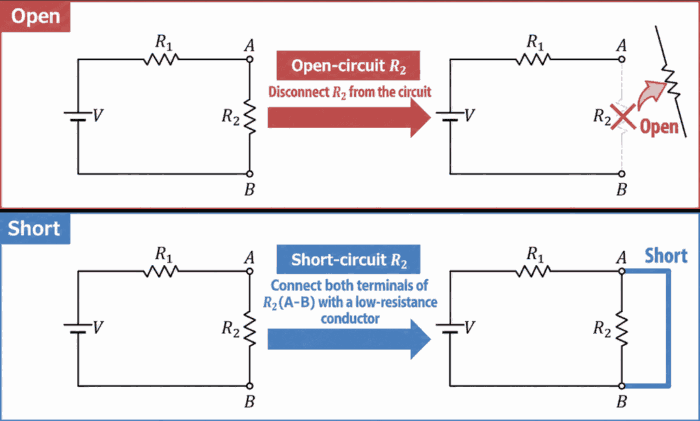
An open circuit is a condition in which part of the circuit is disconnected.
In the diagram above, "leaving resistor \(R_2\) open" means "disconnecting resistor \(R_2\) from the circuit."
A short circuit is a condition in which two points in a circuit are connected by a conductor with very low resistance, such as a wire.
In the diagram above, "shorting resistor \(R_2\)" means "connecting the two terminals of resistor \(R_2\) (points A and B) with a conductor that has very low resistance, such as a wire."
The differences between an "open circuit" and a "short circuit" are summarized below. We will explain them in more detail later.
| Comparison | Open Circuit | Short Circuit |
| Also Called | Open | Short |
| Connection State | Part of the circuit is disconnected | Two points are connected by a low-resistance conductor |
| Ideal Resistance Between A and B | Infinite | \(0{\mathrm{[\Omega]}}\) |
Let us now take a closer look at each term in turn.
What Is an Open Circuit?
An open circuit is a condition in which part of the circuit is disconnected. It is also called an "open."
The following diagram shows a simple circuit consisting of a voltage source \(V\), resistor \(R_1\), and resistor \(R_2\). In this circuit, "leaving resistor \(R_2\) open" means "disconnecting resistor \(R_2\) from the circuit."
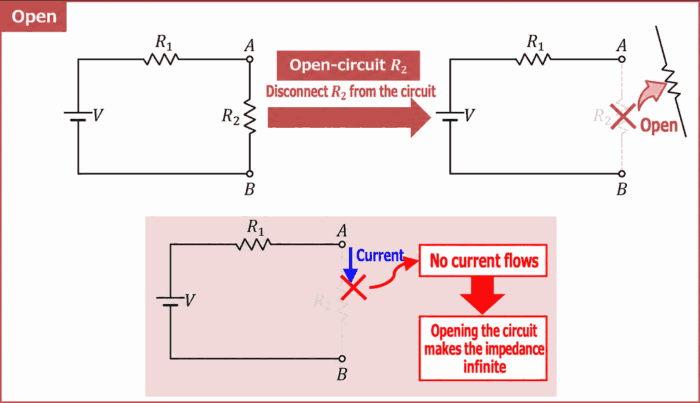
Disconnecting resistor \(R_2\) from the circuit creates a gap between points A and B, opening the circuit. There is no longer a complete path for current to flow around the circuit, so no current flows.
Impedance is a quantity that represents the opposition to current flow. A higher impedance makes it harder for current to flow, and no current flows through a disconnected part of a circuit. For this reason, an open circuit is sometimes described as a condition in which "the impedance becomes infinite."
How Current and Voltage Change Before and After Opening the Circuit
Let us compare the current \(I\) flowing through the circuit and the voltage \(V_{AB}\) between points A and B before and after disconnecting resistor \(R_2\).
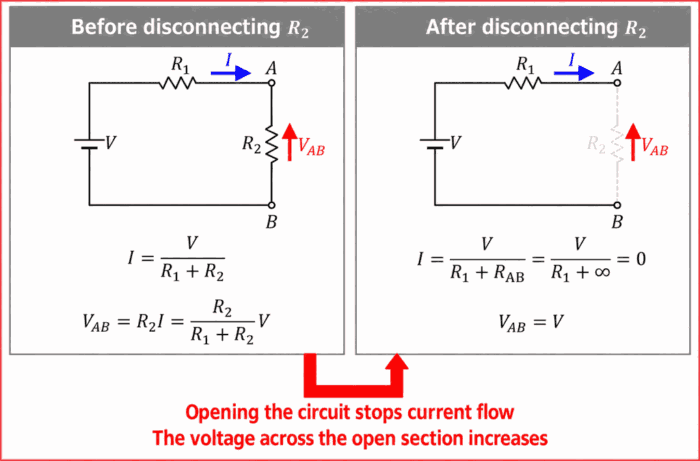
Here, \(V\) is the voltage of the voltage source in \({\mathrm{[V]}}\), \(I\) is the current flowing through the circuit in \({\mathrm{[A]}}\), and \(R_1\) and \(R_2\) are the resistance values of the two resistors in \({\mathrm{[\Omega]}}\). \(V_{AB}\) is the voltage at point A relative to point B, expressed in \({\mathrm{[V]}}\).
Before Disconnecting Resistor \(R_2\)
Before the circuit is opened, resistors \(R_1\) and \(R_2\) are connected in series. Their equivalent resistance is \(R_1+R_2\), so Ohm's law gives the current \(I\) flowing through the circuit as follows:
\begin{eqnarray}
I=\frac{V}{R_1+R_2}
\end{eqnarray}
The voltage \(V_{AB}\) between points A and B is the voltage across resistor \(R_2\). The current through resistor \(R_2\) is also \(I\), so the voltage is given by the following equation:
\begin{eqnarray}
V_{AB}=R_2I=\frac{R_2}{R_1+R_2}V
\end{eqnarray}
The voltage \(V\) of the voltage source is divided between the two resistors. Therefore, before the circuit is opened, \(V_{AB}\) is lower than \(V\).
After Disconnecting Resistor \(R_2\)
When resistor \(R_2\) is disconnected, the resistance between points A and B can be considered infinite. If we denote this resistance by \(R_{AB}\), Ohm's law gives the current \(I\) flowing through the circuit as follows:
\begin{eqnarray}
I=\frac{V}{R_1+R_{AB}}=\frac{V}{R_1+{\infty}}=0
\end{eqnarray}
Disconnecting resistor \(R_2\) makes the circuit current \(I\) zero, so the voltage drop across resistor \(R_1\) also becomes zero. As a result, the voltage \(V\) of the voltage source equals the voltage \(V_{AB}\) between points A and B. This can be expressed as follows:
\begin{eqnarray}
V_{AB}=V
\end{eqnarray}
Thus, in this circuit, "opening the circuit stops current from flowing" and "the voltage across the open section increases."
An OFF Switch Also Creates an Open Circuit
The term "open circuit" does not apply only to removing a component. The following diagram shows a circuit consisting of a voltage source \(V\), a switch \(SW\), and a resistor \(R_1\).
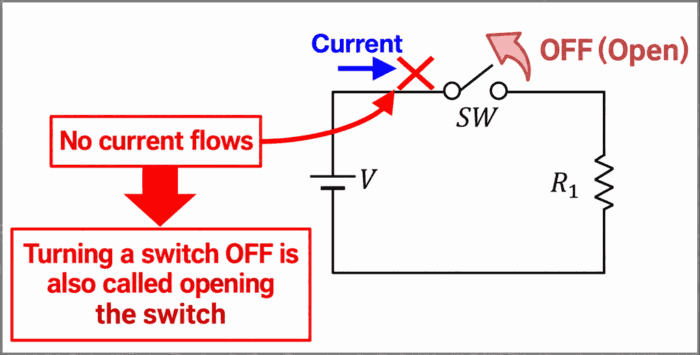
When switch \(SW\) is turned OFF, its contacts separate, disconnecting part of the circuit and stopping current flow.
For this reason, turning a switch OFF is also described as "opening" the switch.
What Is a Short Circuit?
A short circuit is a condition in which two points in a circuit are connected by a conductor with very low resistance, such as a wire. It is also called a "short."
The following diagram shows a simple circuit consisting of a voltage source \(V\), resistor \(R_1\), and resistor \(R_2\). In this circuit, "shorting resistor \(R_2\)" means "connecting the two terminals of resistor \(R_2\) (points A and B) with a conductor that has very low resistance, such as a wire."
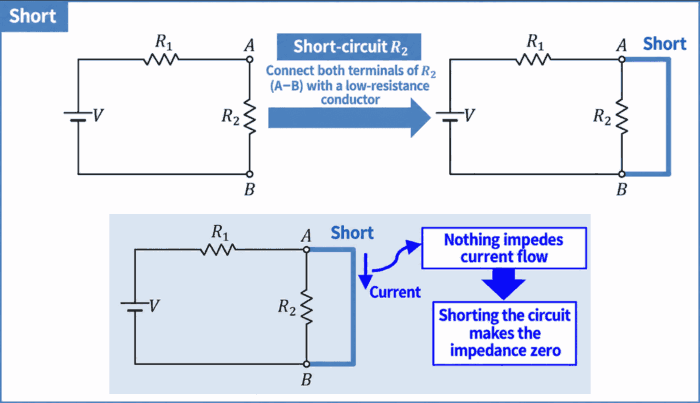
There is nothing to impede current flow through the shorted section. For this reason, a short circuit is sometimes described as a condition in which "the impedance becomes zero."
How Current and Voltage Change Before and After Shorting the Circuit
Let us compare the current \(I\) flowing through the circuit and the voltage \(V_{AB}\) between points A and B before and after shorting resistor \(R_2\).
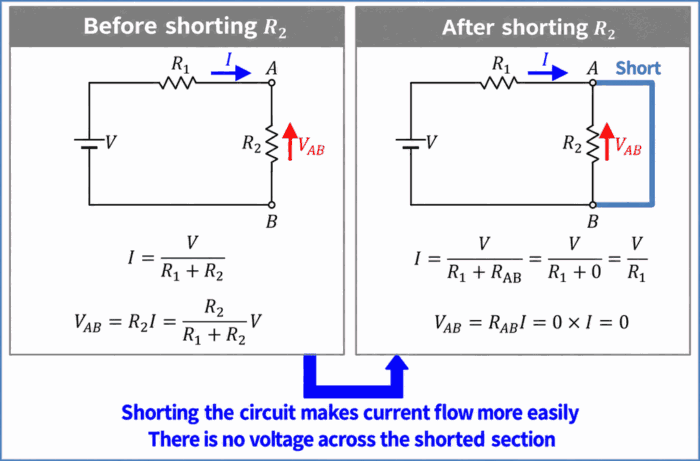
Here, \(V\) is the voltage of the voltage source in \({\mathrm{[V]}}\), \(I\) is the current flowing through the circuit in \({\mathrm{[A]}}\), and \(R_1\) and \(R_2\) are the resistance values of the two resistors in \({\mathrm{[\Omega]}}\). \(V_{AB}\) is the voltage at point A relative to point B, expressed in \({\mathrm{[V]}}\).
Before Shorting Resistor \(R_2\)
Before the circuit is shorted, resistors \(R_1\) and \(R_2\) are connected in series. Their equivalent resistance is \(R_1+R_2\), so Ohm's law gives the current \(I\) flowing through the circuit as follows:
\begin{eqnarray}
I=\frac{V}{R_1+R_2}
\end{eqnarray}
The voltage \(V_{AB}\) between points A and B is the voltage across resistor \(R_2\). The current through resistor \(R_2\) is also \(I\), so the voltage is given by the following equation:
\begin{eqnarray}
V_{AB}=R_2I=\frac{R_2}{R_1+R_2}V
\end{eqnarray}
After Shorting Resistor \(R_2\)
When the two terminals of resistor \(R_2\) are shorted with an ideal conductor, the resistance between points A and B can be considered zero. If we denote this resistance by \(R_{AB}\), Ohm's law gives the current \(I\) flowing through the circuit as follows:
\begin{eqnarray}
I=\frac{V}{R_1+R_{AB}}=\frac{V}{R_1+0}=\frac{V}{R_1}
\end{eqnarray}
Also, because the equivalent resistance \(R_{AB}\) between points A and B is zero, the voltage \(V_{AB}\) between them is also zero. This can be expressed as follows:
\begin{eqnarray}
V_{AB}=R_{AB}I=0×I=0
\end{eqnarray}
Thus, in this circuit, "shorting the circuit makes it easier for current to flow" and "there is no voltage across the shorted section."
Caution: A Short Circuit Can Cause a Very Large Current
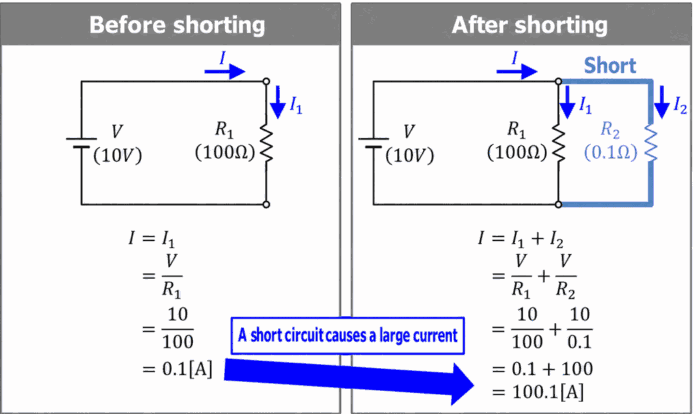
The following diagram shows a simple circuit consisting of a voltage source \(V=10{\mathrm{[V]}}\) and a resistor \(R_1=100{\mathrm{[\Omega]}}\). Let us consider a circuit in which resistor \(R_1\) alone determines the current.
We will calculate the current \(I\) flowing through the circuit before and after shorting resistor \(R_1\) with a low-resistance conductor whose resistance is \(R_2=0.1{\mathrm{[\Omega]}}\).
Before Shorting with a Low-Resistance Conductor (\(R_2=0.1{\mathrm{[\Omega]}}\))
Before the resistor is shorted, current can flow only through resistor \(R_1\). The circuit current \(I\) is therefore equal to the current \(I_1\) through resistor \(R_1\). Using Ohm's law, we obtain:
\begin{eqnarray}
I=I_1=\frac{V}{R_1}=\frac{10}{100}=0.1{\mathrm{[A]}}
\end{eqnarray}
After Shorting with a Low-Resistance Conductor (\(R_2=0.1{\mathrm{[\Omega]}}\))
After the resistor is shorted, resistor \(R_1\) and the conductor resistance \(R_2\) are connected in parallel. Both have \(10{\mathrm{[V]}}\) across them, so current \(I_1\) flows through resistor \(R_1\), and current \(I_2\) flows through the conductor. The current \(I\) supplied by the voltage source is the sum of these currents, giving the following value:
\begin{eqnarray}
I=I_1+I_2=\frac{V}{R_1}+\frac{V}{R_2}=\frac{10}{100}+\frac{10}{0.1}=0.1+100=100.1{\mathrm{[A]}}
\end{eqnarray}
Before shorting, the circuit current \(I\) is \(0.1{\mathrm{[A]}}\). After shorting, the circuit current \(I\) is \(100.1{\mathrm{[A]}}\). This shows that shorting a circuit can cause a very large current to flow.
The current that flows during a short circuit is called "short-circuit current." This current can melt the wire insulation (the insulating polymer covering the wire). Sparks produced during a short circuit can also cause a fire or other serious problems.
Summary
This article explained the following points about "the difference between open and short circuits":
- An open circuit (open) is a condition in which part of the circuit is disconnected.
- A short circuit (short) is a condition in which two points are connected by a conductor with very low resistance, such as a wire.
Thank you for reading.